
Indian Oil Corporation, Hindustan Petroleum Corporation and Bharat Petroleum Corporation are losing Rs 486 crore (Rs 4.86 billion) per day as they are made to sell diesel, domestic LPG and kerosene way below cost to keep inflation under check.
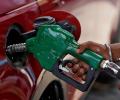
State-owned Indian Oil Corp (IOC) on Friday said international oil prices have been range-bound in the last few weeks, warranting no revision in retail petrol and diesel rates. While petrol price hasn't changed since September 22, diesel rates have been static from October 2.

Diesel prices are raised every month by up to 50 paise per litre to trim the losses. Rates were last raised on August 1 after which losses had dipped to Rs 1.33.
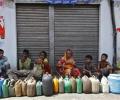
The staggered increase in kerosene rate may not have the same impact of freeing up the fuel price as for diesel.
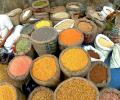
Prices of food items like cereals, pulses, and edible oils rose or remained steady in May, a Reserve Bank of India (RBI) report said, indicating there could be another higher inflation print. However, it observed that the Monetary Policy Committee's (MPC's) surprise move to increase interest rates bodes well for its credibility. The RBI's monthly State of the Economy report, released on Tuesday, citing high frequency food price data from the Ministry of Consumer Affairs for the period May 1-12, said the increase in the prices of cereals was primarily because of the surge in wheat prices.
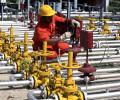
The government has ordered Oil and Natural Gas Corp (ONGC) to pay a near-record Rs 13,764 crore as fuel subsidy for the December quarter, a move that will dent the firm's profitability.
In the domestic segment, demand is currently led by rural markets, oil and gas, LPG and B2C segments like roofing and sheeting.

Prices of petrol were reduced 32 times and increased 21 times while diesel prices were slashed 19 times and raised 28 times since 2013.

Moily insisted that no proposal has been moved to the Cabinet for raising diesel rates beyond the 40-50 paise a litre monthly increase, which has been implemented since January.
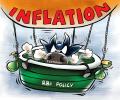
RBI Governor Shaktikanta Das on Friday said that inflation is on a declining trajectory, as it has fallen by 170 basis points from its January 2020 peak. Retail inflation fell to four-month low of 5.91 per cent in March over the previous month, mainly due to easing food prices.

Empowered group of ministers on fuel pricing was likely to meet soon.

The government on Friday said it will not increase prices of domestic cooking gas (LPG) and kerosene despite the Budget cutting to half the subsidy on the two mass consumed cooking fuels from April 1.

The loss, which is made good through government subsidy, has declined since March as the rupee strengthened against the dollar and global oil prices softened.

The government on Thursday more than doubled the price of natural gas that is used to produce electricity, make fertilisers, turned into CNG and piped to household kitchens for cooking, on the back of a spike in global energy prices. The price of gas produced from old regulated fields, such as the nation's largest gas field of Bassein of ONGC, will rise to a record high of $6.10 per million British thermal unit (mmBtu) from the current $2.90 per mmBtu, according to the oil ministry's Petroleum Planning and Analysis Cell (PPAC). The new price, which is likely to result in a hike in CNG and piped cooking gas rates, will be for six months beginning April 1.

State-owned oil firms such as ONGC and IOC will invest over Rs 1.11 lakh crore in the next fiscal year starting April as they supplement the government's massive spending programme to spur economic growth. Oil and Natural Gas Corporation (ONGC), Indian Oil Corporation (IOC), GAIL (India) Ltd, Bharat Petroleum Corporation Ltd (BPCL), Hindustan Petroleum Corporation Ltd (HPCL) and Oil India Ltd (OIL) will together make a 7.4 per cent higher capital expenditure in the 2022-23 fiscal (FY23). The capex spending of Rs 1.11 lakh crore in 2022-23 compares with a revised estimate of Rs 1.04 lakh crore for the current fiscal year that ends in March, according to Union budget documents.

International oil prices retreated from an over seven-year high but was still above $100 a barrel and continue to pose threat to India's inflation rate and current account deficit. While there are no supply concerns as the oil route remained open, consumers will feel the pinch when PSU oil firms start passing on the increase in international rates through a revision in petrol and diesel prices, which have been on a pause for over three-and-a-half-months in view of elections in Uttar Pradesh and four other states. The government is "closely monitoring the situation" and will "take appropriate steps as and when required", a top official said. Brent crude oil surged past $105 per barrel on Thursday for the first time since August 2014, following Russia's invasion of Ukraine.

The retail selling price of petrol at Delhi would come down by Rs 1.82 a litre.

Congress leader Rahul Gandhi on Wednesday slammed the government over the rising price of domestic cooking gas, diesel and petrol, and alleged that an amount of Rs 23 lakh crore has been earned by increasing prices of these commodities in the last seven years.
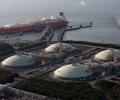
Around 15 years ago, when Reliance Industries (RIL) struck natural gas in the Krishna-Godavari (KG) basin off the east coast, the government made plans to supply that fuel cheaply to scores of generators that sprang up in India triggered by the discovery. Most of the plants, which account for 6 per cent of India's total generation capacity, operate sparsely after the KG-D6 area first failed to meet production targets, and then finally shut shop. Affordable domestic gas was why those thermal plants came up and the rate of the fuel today is why those generators hardly operate. Record liquefied natural gas (LNG) rates may yet again unravel India's ambitions to expand use of gas in industries, households and vehicles. Rates, while volatile, may stay strong this decade as developed nations with higher purchasing power embrace gas as the transition fuel.

The price of petrol breached a three-year high on Monday at Rs 74.50 a litre, while the price of diesel was at its highest at Rs 65.75 a litre

Petrol prices on Thursday crossed Rs 73 a litre mark, the highest level since the BJP government came to power in 2014, while diesel touched a record high of Rs 64.11 a litre.
Petroleum Minister Mani Shankar Aiyar on Thursday denied having presented to the Cabinet a proposal for raising LPG and kerosene prices.
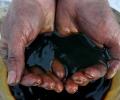
India's crude oil import bill is set to exceed $100 billion in the current fiscal year ending March 31, almost double its spending last year, as international oil prices trade at seven-year highs. India spent $94.3 billion in the first 10 months (April-January) of the ongoing financial year that started April 1, 2021, according to data from the oil ministry's Petroleum Planning & Analysis Cell (PPAC). It spent $11.6 billion in January alone when oil prices had started to surge.
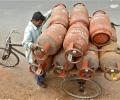
India's cities must switch over to piped gas leaving LPG cylinders.
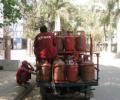
The connections will be released on completion of Know Your Customer formalities and de-duplication of the applicants across all the three Oil Companies to ensure that multiple connections are not released.

After grappling with the issue for two years, the Ministry of Petroleum and Natural Gas had on November 21 ordered that the margin to be charged, over and above the gas sale price, should be fixed between the seller and buyers in all sectors other than urea and LPG.

Petrol price on Friday crossed the Rs 100- per-litre mark in Chennai as well as in some places in Punjab and Kerala after fuel prices were hiked yet again. Petrol is priced at over Rs 99 a litre in Delhi and Kolkata -- the only metro cities which haven't seen the Rs 100 mark yet. Petrol price was hiked by 35 paise per litre on Friday but there was no change in diesel rates, according to a price notification of state-owned fuel retailers.

In 2017, a consortium led by Russian state oil company Rosneft agreed to buy Essar Oil for $12.9 billion in India's biggest foreign acquisition of a homegrown company. Rosneft's buyout of Essar's assets was meant to herald a wave of energy investments in India - over six decades after Esso, Caltex and Shell invested in India's refining sector in the 1950s. But the government has tripped up in its efforts to sell Bharat Petroleum Corporation Ltd (BPCL), formerly Burmah Shell, a blue chip public sector company. Bidders include a couple of global funds and resources firm Vedanta.
.jpg)
The Oil Ministry on October 31 issued orders asking upstream oil and gas producers like ONGC and Oil India Ltd to give Rs 16,729.74 crore (Rs 167.29 billion) to make up for 47 per cent of the Rs 35,328-crore (Rs 353.28 billion) revenue that retailers lost on selling diesel, domestic LPG and kerosene at government controlled rates in second quarter.

Re-instatement of 5% custom duty on crude imports will help.

India's fuel demand in May slumped to its lowest in nine months as restrictions to curb the second wave of COVID infections stalled mobility and muted economic activity. Fuel demand fell 1.5 per cent to 15.1 million tonnes despite the low base of May 2020 and was down 11.3 per cent when compared to the previous month, according to data from the Petroleum Planning and Analysis Cell (PPAC) of the oil ministry. India was under one of the world's strictest lockdowns in May last year, which brought all mobility and economic activity to a grinding halt.

In a marathon address to the nation from the ramparts of the Red Fort, Prime Minister Narendra Modi on Saturday underlined India's unity and diversity and the progress of his 15-month-old government's policies.

While the likelihood of these states going the Lanka or Greece way may be an alarming assessment, the financial situation of some states such as Punjab and West Bengal is indeed quite weak.
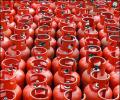
In a move that will give cooking gas consumers more choice, state oil marketing companies have started selling mini 5-kg LPG cylinders at subsidised rates.
The growth, however, may not indicate a major revival of economic activity.
The government on Tuesday increased the distributors' commission on domestic cooking gas (LPG) by 38 paise on a 14.2 kg cylinder and by 20 paise on a 5 kg cylinder, resulting in an equivalent increase in the prices of the fuel.
 © 2026 Rediff.com - Investor Information - Advertise with us - Disclaimer - Privacy Policy - Sitemap - Feedback - About us - Terms of use - Grievances